
What is micro private equity?
The behind-the-scenes business model powering your favourite influencer

Clue in the name, micro private equity is simply private equity but with much smaller deal sizes. Traditional, institutional players don’t look at these deals because they would have to do 100s of them to deploy all their capital. This presents an opportunity for the rest of us to steal the PE playbook and negotiate our way to a personal empire. So instead of finance bros in fancy offices, think indie hackers, influencers and your rich neighbour. Consider this your 101 introduction to the burgeoning industry. I’m going to start from ground zero so feel free to skip ahead if you already know the basics.
What is private equity?
Private equity is a business model where investors exchange money (capital) for ownership (shares, equity) in a company. The reason it is “private” is because the shares are not available to the public via an exchange, they are bought through a private deal. Investors buy these shares betting they will be more valuable to sell in the future.
There are three money-making levers that investors can pull:
1. Leverage is when you fund an equity purchase with debt. If you have $1M and use 80% leverage, you could buy shares worth $5M. The key is that the business must cover interest payments and gradually repay the principal (the $4M debt). Too much leverage is risky, if the business underperforms, you could lose collateral. You can do a lot with leverage; check out this incredible story where Sarah bought a $20M business (not so micro) with 100% leverage — that’s right, zero cash upfront.
2. Value creation basically means improving the company you own. Businesses are valued on a multiple of profit (or EBITDA, a more accurate measure of operational profitability). By increasing profit, you increase the value of your shares. This can be done by raising revenue or cutting costs. The stereotype of ruthless private equity firms firing half of the employees is one form of value creation, but there are many others — some typical ones used in big PE are new management, specialised consultants, shared services, and financial engineering.
3. Multiple expansion means increasing the profit multiple a company is valued at. Different company sizes fall into valuation “buckets” based on risk and revenue defensibility, so growth alone can lift your multiple. Industry and macro play a big role here. Business value comes from predicting future cashflows and discounting them back to today to reflect time, risk, and inflation (DCF). High-growth sectors like AI and biotech command higher multiples since future cashflows are expected to rise sharply, unlike trad media, which faces serious headwinds. Another way to benefit is multiple arbitrage; if you own a company doing $10M at 10× ($100M) and acquire another doing $1M at 5× ($5M), the combined company now does $11M at 10× ($110M), instantly creating $5M in value (pretty cool right). This is why many PE buyers use roll-up strategies, which I’ll touch on later.
A common analogy for private equity is house flipping. You buy a house with a mortgage (leverage), fix it up (value creation), and bet that prices will rise because a new school is being built nearby (multiple expansion, kind of).
When you combine all three, the power becomes clear:
You buy a business for $100,000 using 60% debt at 3× profit. You double profits with your domain-specific expertise, pay off the principal, and sell at 4× profit. You’ve just turned $100,000 into $668,000 in a year.
Traditional finance and the rise of micro private equity
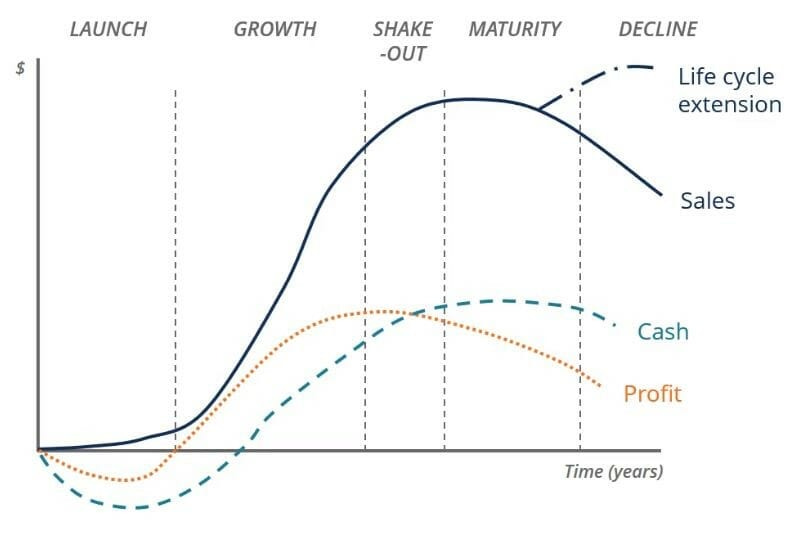
The traditional finance world is built around the idealised business lifecycle, the zero to hero American dream. Start from nothing, scale until you’ve created the next Walmart or McDonald’s. It follows this path:
Venture capital → Growth equity → Leveraged buyouts → Initial public offering (IPO)
Venture capital bets on many of promising founders and ideas. It operates on a power law, hoping a few blow up and become unicorns.
Growth equity is the scale-up stage. It backs businesses that have definitive product-market fit and need money for new product offerings, geographic expansion or strategic acquisitions.
Leveraged buyouts work with mature and stable companies that have the balance sheet strength to withstand a mountain of debt. PE buyers use financial engineering to maximise the debt load and slowly pay it off to get predictable and lucrative returns.
An IPO gives the opportunity for significant multiple expansion and exit liquidity. This is an extraordinary accomplishment (the golden end-state that finance bros dream about).
In this framework, small companies are not profitable at all. Most of them run at a loss, burning through ad spend to gain traction until the unit economics start to make sense. The venture industry is very much go big or go home, you’re either the next big thing or a flop.
Micro private equity fits adjacently to this, small businesses that are already producing strong and defensible cash flows. They often exist in niche areas and solve specific pain points really well. They are outliers not built to follow the default path. I use “micro private equity” really as an umbrella term, also covering things like venture buyouts, HoldCos, search entrepreneurship and acquire-and-operate.
The new wave of micro PE has come about because of the erosion of important barriers to entry:
The internet has massively democratised access to information and education. Most people have no idea buying a business is an option for them or how to get started.
Previously, buying a business came with the cost of expensive professional services. You needed accountants for proof of earning, we now have Stripe. You needed lawyers for drafting the paperwork, we now have AI template builders.
We now have unprecedented digital operating leverage with SaaS, AI and remote workers. It has never been easier than now to run a business (but also there has never been more competition).
The emergence of M&A marketplaces (listed below) has reduced the massive activation hurdle of finding a business to buy or someone to buy yours.
There’s been an explosion of niche, profitable internet businesses that never existed before.
For physical businesses, especially in Europe and America, there’s currently this phenomenon known as the ‘silver tsunami.’ A whole generation of Baby Boomers have children that don’t want to carry on the family business. They are looking for an exit so they can finally retire.
Big players in the space
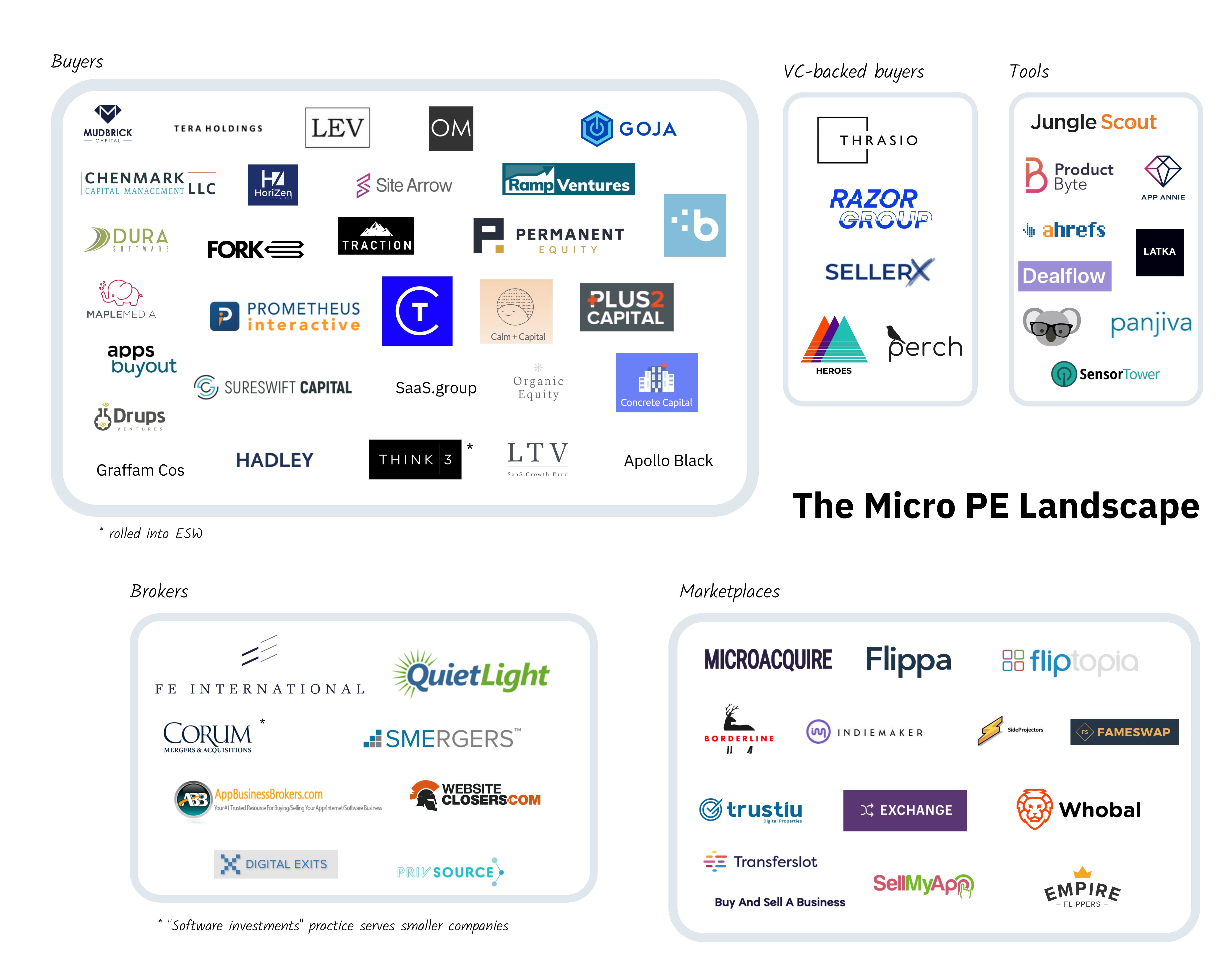
To help you get a better sense of the industry, here’s a list of big players in the space right now.
Acquirers: these are successful investors, most of whom have raised funding rounds, to build a portfolio of digital assets.
Tiny, Bending Spoons, SureSwift Capital, XO Capital, Fork Equity, Verne, Skaling Ventures
Marketplaces: if you’re looking to buy or sell a business, don’t waste time with cold email (although you may find some hidden gems). These marketplaces are your best bet to connect with serious opportunities.
Service Providers: there are now some great due diligence and advisory services and even capital providers supporting the industry.
Courses: if you’re interested in learning more, here are two great courses and one podcast I recommend.
How to Buy, Grow, and Sell Startups, Indie PE, HoldCo Builders
For an even deeper dive, check out this industry map from The Generalist:
Your favourite influencer uses this model
Alongside the more dedicated and technical players I listed above, many influencers are leveraging their unique distribution advantage to play the PE game. This is the next step up from affiliate deals and sponsorships, creators are now seeing the rewards of owning a chunk of the businesses they partner with. The most high profile one in recent news is Kim Kardashian co-founding PE firm SKKY Partners (also not so micro haha).
So creators are playing the PE game, and what’s more PE people are now playing the content game. Taking a look at the top business influencers, many have a background in acquisition entrepreneurship.
Codie Sanchez is the flag-bearer of buying “boring businesses” and how everyday people can steal the finance world’s trade secrets to build their personal empires. Alongside her career, she began by acquiring local vending-machines and laundromats and has built this up to become Main St. Hold Co.
Sahil Bloom, like Codie, spent years learning the ins and outs of PE. As a popular creator, he doesn’t sell any courses or communities so where does his income come from? In the background, he owns SRB Holdings which he fuels with his unique content advantage. He copied the Amazon model, basically turning his cost-centres as a creator into profit-centres.
Alex Hormozi’s main business is Acquisition.com where he applies his high-signal business brain, forged through years of experience, to invest in and scale North American companies.
Andrew Wilkinson, founder of Tiny, is known as the Charlie Munger of internet businesses. Tiny is the OG of micro PE and grew initially by rolling up Shopify theme and apps. He took advantage of the “barnacle on a whale” strategy where his businesses attached to and rode the growth wave of a larger platform.
These superstars all took advantage of the same playbook, buying and growing cash-flowing assets. Interestingly, they are all now playing in the early-stage VC space (maybe a post for another time).
Opportunities and multiples
Opportunities in the micro PE space can first be categorised into digital and physical.
Digital businesses are great because 1) you can reach anyone in the world and 2) for code and media, the marginal cost of replication is zero which can make operations extremely profitable (not really any unit economics). Also on a personal note, you can achieve the holy trifecta — time, location and financial freedom.
The three main types of digital business are SaaS, e-commerce and content:
SaaS / AI tends to sell for the highest multiples because of the subscription-based revenue. If churn is low, this means you are buying a predictable existing customer base. For AI applications with usage-based pricing, there is more uncertainty, so lower multiples.
E-commerce tends to be cheaper, unless there is also subscription or strong re-occurring revenue (i.e. repeat buyers of disposable goods). You’re really paying for the brand recognition and existing momentum from marketing efforts.
Content, courses and communities is an opportunity people are only now waking up to. Communities can warrant high multiples (but many struggle with high churn unless they consistently deliver new value). The biggest drawback with this group is often key person dependency — the seller is the face of the brand and holds all the trust and authority. In this case, it would be critical to negotiate a hold-back / partnership agreement.
Physical businesses are great because you don’t have to outclass everyone in the world, just everyone in your local area. These are the ones the Codie Sanchez crew promote — vending machines, wash-and-folds, car washes, HVAC. Overlooked, hidden gems with a strong geographic moat.
Businesses sell at a range of multiples for all kinds of different reasons. Here are a few:
Revenue quality → Recurring revenue is the best, followed by re-occurring revenue. One-time purchases are the weakest, since you have to win over a new customer for every cash inflow.
Risk and defensibility → Factors like customer concentration (few customers = high dependency) and churn (rate at which customers leave) are key. You’re essentially assessing whether the business has economic moats.
Growth potential → Businesses are valued based on their future cash flows, so those with massive growth potential can command higher multiples. The secret is to find a business where you see that potential but the seller doesn’t.
Reason for selling and buying → This is especially important in micro deals. Some sellers are just floating the idea of an exit, some people desperately need the money. Buyers might justify paying a higher-than-average multiple if they know they can make transformative improvements to the business.
Rule of 40 → This is a quality filter often used in growth equity, it has some carryover to micro PE also. A business is considered worthwhile if revenue growth (%) + EBITDA margin (%) ≥ 40.
The key mental models behind the strategy
Let’s break down some of the key mental models that make the micro PE strategy compelling.
Product-market fit means going from 0 to 1, solving a meaningful problem with a product or service that people are willing to spend their hard-earned money on. This is no easy feat. VC investors Marc Andreessen famously said “the only thing that matters in getting to product-market fit.” By acquiring rather than founding a company, you get to skip the stage that has the highest failure rate. There is hard-cash proof of demand in the marketplace and going from 1 to 10 is a much more systemic and repeatable process.
Ownership of assets is the foundation of building wealth. Naval says “you’re not going to get rich renting out your time. You must own equity — a piece of a business — to gain your financial freedom.” One of Britain’s richest men, Felix Dennis, has a personal philosophy of ownership above everything. In his book, How to Get Rich, he talks about fighting tooth and claw to get as close to 100% equity in any business he was in. Micro private equity and deal-making are your ticket to playing the ownership game at a small scale and trading your way up to the top.
Roll-ups are where you acquire a portfolio of similar assets into one entity. This allows you to take advantage of synergies, such as shared costs and cross-selling products to the same audience. You can also develop a specialist expertise in that area and instantly create value through multiple arbitrage. Check out the brilliant story of Syed Balkhi who rolled up a portfolio of WordPress plugins as well as gas stations.
Step functions are ways in which you can create great value quickly in your acquisition because of some unique advantage you have over the previous owner. Andrew Wilkinson calls this his 1 + 1 = 100 M&A framework. This is the principle behind influencers who have built “earned media” and can immediately boost sales by promoting the product.
Seller financing, relationships and reputation. It’s hard to find lenders with these small and alternative deals. There are schemes like SBA loans in America that many people use, but even with these the approval process can take months. What is more common in micro deals is seller financing. This is where the seller is your lender and you pay them back with the profits you make from the business over time. Making this type of deal requires a great deal of trust between the buyer and seller. In micro private equity, and more so in life, your reputation is golden and it compounds over time.
The end points that make the grind worthwhile
The reason why investment banking is a multi-billion dollar industry is because so much value can be created by maximising the transaction points where company ownership is transferred. The high-value network and deal structuring skills that advisors bring to the table can’t be overlooked.
Take this simple example:
You go at it by yourself with $100k. You buy equity at 4x profit, 50% leverage and then sell your shares later on at 5x profit, making $250k, pretty nice.
Now, let’s say you hire an advisor. With the same $100k, they use their deal-making skills to help you buy at 3x profit and through their network they find you an additional lender so you can use 75% leverage. Later on, you sell the same shares at 6x profit, coming home with $800k. If you pay the expert $50k (very generous), you still end up with $750k — three times more than when you went at it alone for the same amount of operational work.
After you’ve put in years of grind to grow a business, making the most out of these end points is what makes all your hard work worthwhile.
Thanks so much for reading! What did you think? Drop a comment below.
All the best,
Amani
Not only was this very informative and interesting, but it’s been written so well. Hope to see more content like this!
Another excellently written gem by a talented communicator - keep going and enjoy your journey.
Thanks for the mini PE education too